Flight Analysis & Range Guide
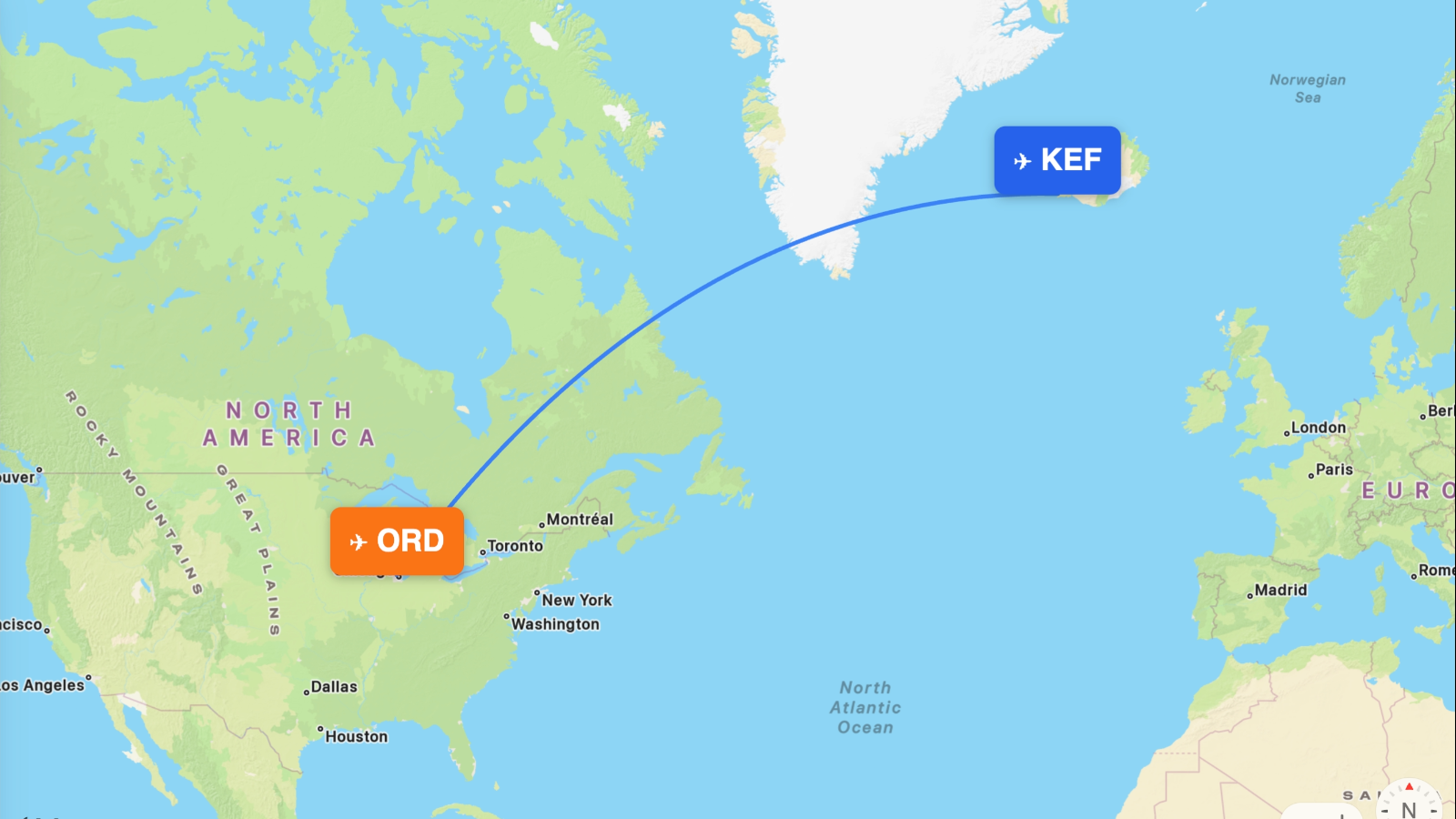
For decades, Icelandair was a Boeing airline. Their entire transatlantic operation ran on the Boeing 757 - a narrow-body twin that did long, thin ocean crossings better than almost anything else ever built. Then Boeing discontinued the Boeing 757 in 2004. When Icelandair needed to evolve their fleet, Boeing had no direct replacement to offer. The Airbus A321LR was waiting in the wings.
Icelandair’s hub at Keflavik (KEF) is the entire business model - Iceland as a mid-Atlantic stopover, connecting North America to Europe. Their US routes span a wide range of distances:
None of these routes are long enough to justify a Boeing 787 Dreamliner - you’d be flying a 250-seat widebody on routes that generate 175 bookings on a good day. The operating economics collapse. What Icelandair needs is a narrowbody with roughly 180 seats and enough range to cover all of these destinations at full load.
Here’s where Boeing runs into trouble. The Boeing 757-200 - Icelandair’s workhorse - carried 184 passengers and could fly 3,900 nm at maximum structural payload. Every single one of Icelandair’s US routes fit comfortably within that envelope.
Boeing’s current narrowbody, the Boeing 737 MAX 8 and Boeing 737 MAX 9, tops out at 3,550 nm at max payload. That’s fine for Boston and New York. But Seattle at 3,138 nm? That’s dangerously close to the limit - add a winter headwind and you’re restricting payload or rerouting. The Boeing 737 MAX doesn’t give Icelandair the comfortable margin their western US routes need.
The Airbus A321LR solves this cleanly. At 4,000 nm max payload range, it covers every Icelandair US destination with room to spare - even in winter, even at full load. It carries ~180 passengers in a typical Saga Class + Economy layout. It is, in almost every measurable dimension, what the Boeing 757 would have been if Boeing had kept developing it.
Icelandair didn’t defect to Airbus out of preference. Boeing simply had no equivalent product. The Boeing 757 was discontinued. The Boeing 737 MAX can’t match its range. The Boeing 787 Dreamliner is the wrong size and the wrong economics for thin North Atlantic routes.
The Airbus A321LR (and now the Airbus A321XLR, with 4,700 nm max payload range) slots directly into the niche the Boeing 757 vacated. Same passenger count. Longer range. Two decades of engine and aerodynamic improvements that slash fuel burn by roughly 20% over the Boeing 757’s CFM56 or Rolls-Royce RB211 engines. The Airbus A321XLR in particular opens routes like KEF–Denver (3,093 nm) and KEF–Seattle with real margin instead of white knuckles.
The question was never “Boeing or Airbus.” It was “what aircraft can actually do this job?” and Boeing stopped making it.
See range, specs, and airline configs on PlaneRange:
A321neo LR A321XLR 737 MAX 8 Visualize on the Map →