Back to Analysis

The Great Circle: Why planes fly over the North Pole

Flight Analysis & Range Guide
The Great Circle: Why planes fly over the North Pole
Visualize this on the interactive map

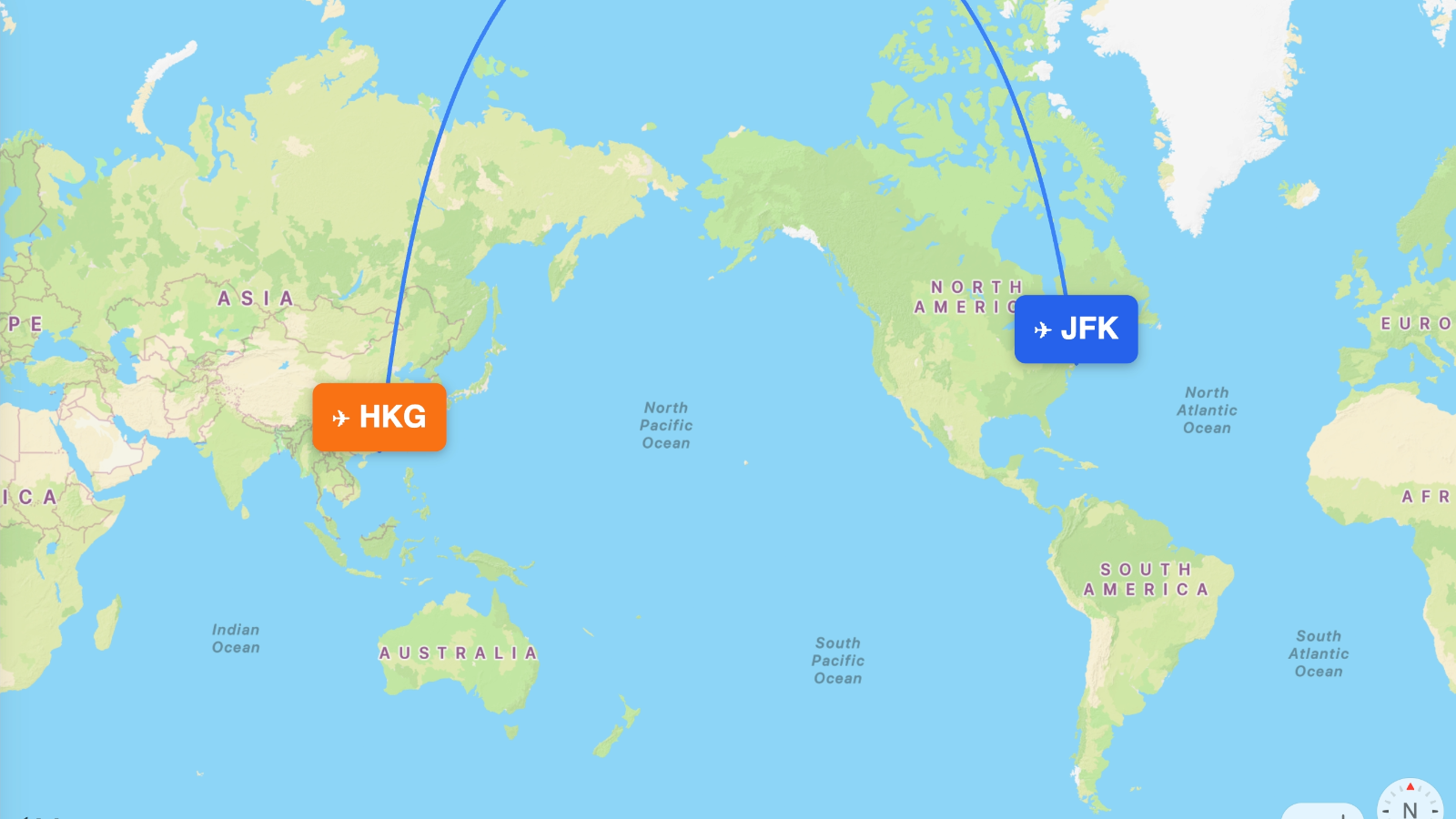
If you look at a standard Mercator map, a flight from New York (JFK) to Hong Kong (HKG) looks like it should trace a straight line across the Pacific. However, the shortest distance on a sphere is a Great Circle arc, which takes the aircraft straight north through Canada, over the Arctic Circle, and down through Russia.

Geodesic Math on a Sphere

Because the Earth is a sphere, flying "over the top" shaves thousands of miles and several hours of flight time off ultra-long-haul routes. PlaneRange uses accurate Great Circle math in the background, which is why the range "rings" look distorted and stretch out as they approach the poles.

The Dangers of Polar Routing

Flying over the North Pole isn't just about drawing a line; it requires specialized preparation. Airlines face extreme operational challenges:

  • Cold Fuel Limits: At polar altitudes, temperatures can drop below -70°C. Jet A fuel begins to freeze at -40°C. Pilots must actively monitor fuel temperatures and occasionally descend to warmer air.
  • Arctic Alternates: If a plane loses an engine over the pole, it must divert to some of the most isolated airports on Earth, such as Thule Air Base (Greenland) or Svalbard (LYR).
  • Space Weather: High-frequency (HF) radios are highly susceptible to solar flares at the poles, occasionally forcing airlines to reroute flights further south to maintain communication.
Explore Great Circle routes from New York →

Explore These Aircraft

See range, specs, and airline configs on PlaneRange:

A350-900 A350-1000 A380-800 747-400 767-300ER 777-200ER 777-300ER 777X-9 Visualize on the Map →

Routes & Range

New routes pushed to their limits, new aircraft, and features as they land.