Flight Analysis & Range Guide
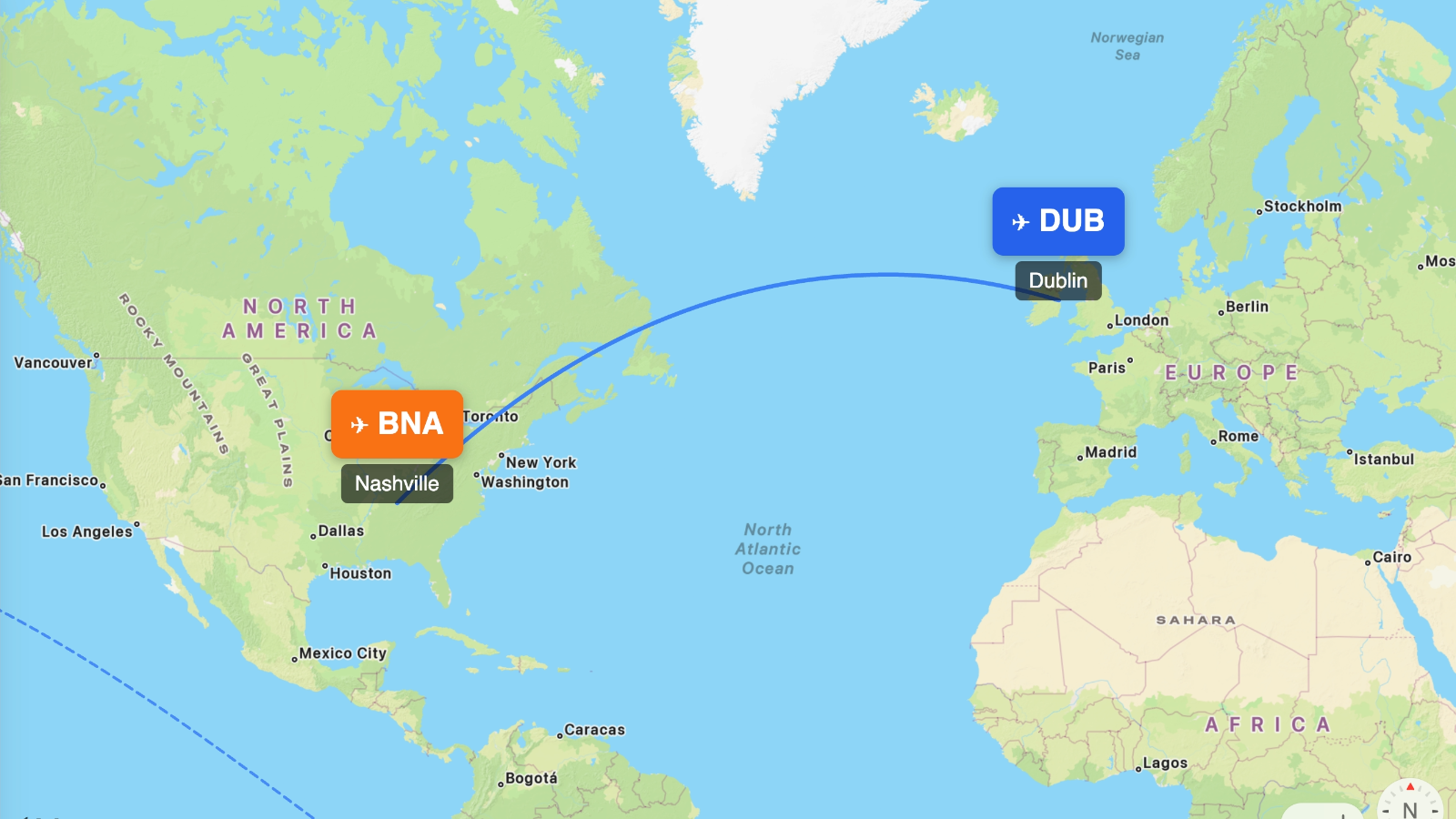
London is the undisputed gateway between Europe and North America. Heathrow handles more transatlantic passengers than any airport on earth. And yet, if you are an airline trying to launch a new transatlantic route in 2025 — a narrowbody to a mid-sized US city, a low-cost service to Boston, a thin route that can’t fill a Boeing 787 Dreamliner — Dublin is a better starting point than London. The reasons are geographic, regulatory, and economic, and together they have made Dublin Airport (DUB) one of the most strategically valuable pieces of real estate in commercial aviation.
Dublin sits at 53.4°N, 6.3°W — meaningfully further west and slightly further north than London Heathrow at 51.5°N, 0.5°W. On a globe, that translates directly into shorter transatlantic crossings:
That consistent 236 nm saving is not dramatic on a long-haul widebody — it’s about 30 minutes of flight time. But for a narrowbody jet operating near the edge of its range, 236 nm is the difference between comfortable and marginal, and marginal in aviation quickly becomes operationally impossible.
A Boeing 787 Dreamliner or Airbus A350 can cross the Atlantic from almost anywhere in Western Europe with fuel to spare. The range advantage of Dublin doesn’t matter much for a plane with 8,000 nm in the tank. But a modern narrowbody like the Airbus A321neo LR — with a maximum payload range of 4,000 nm — is operating in a completely different risk envelope.
From Dublin, the Airbus A321neo LR reaches JFK with 1,245 nm of margin even at maximum payload. That’s enough buffer to absorb winter headwinds, carry full cargo, and still land with legal reserves. From London, the same plane covers the same route with 1,009 nm of margin — workable, but tighter, and noticeably more sensitive to seasonal wind variation.
The narrowbody advantage is economic. A 180-seat Airbus A321neo burns dramatically less fuel per flight than a 300-seat Boeing 787. On a route where you can’t fill 300 seats — say, Dublin to Pittsburgh, or Dublin to Hartford — the narrowbody unit economics work where a widebody would fly half-empty and lose money on every departure.
Geography alone would make Dublin useful. The US Customs and Border Protection Pre-Clearance facility makes it uniquely valuable.
Dublin is one of only a handful of airports outside the United States where passengers clear US customs and immigration before they board the plane. When the flight lands in America, it arrives as a domestic flight. This has a transformative effect on which US airports can receive the service: Cleveland (CLE), Hartford (BDL), Providence (PVD), Pittsburgh (PIT) — airports without full international customs facilities — can all accept Dublin arrivals because there is nothing left to clear.
While Iberia was the global launch customer for the XLR in late 2024 (using it on Madrid–Boston), Aer Lingus has used the type to double down on its pre-clearance hub strategy. They have built a network of secondary US cities that no other European carrier serves nonstop. It is not a coincidence that the world’s largest hub for narrowbody transatlantic operations has both the geographic position and the pre-clearance facility.
Aer Lingus built its entire long-haul business model on this insight, operating Airbus A321neo LR and Airbus A321XLR aircraft to a roster of US cities that would be commercially unviable on widebodies. American Airlines, United Airlines, and Delta Air Lines all run transatlantic services through Dublin, partly to access the pre-clearance facility.
The Airbus A321XLR, with its 4,700 nm maximum payload range, extends this model further west. From Dublin, it comfortably reaches Chicago, Dallas, and Denver — routes that previously required a widebody. As more XLRs enter service, the number of US cities with nonstop Dublin access is expected to grow substantially.
See range, specs, and airline configs on PlaneRange:
A321neo LR A321XLR 737 MAX 8 Visualize on the Map →