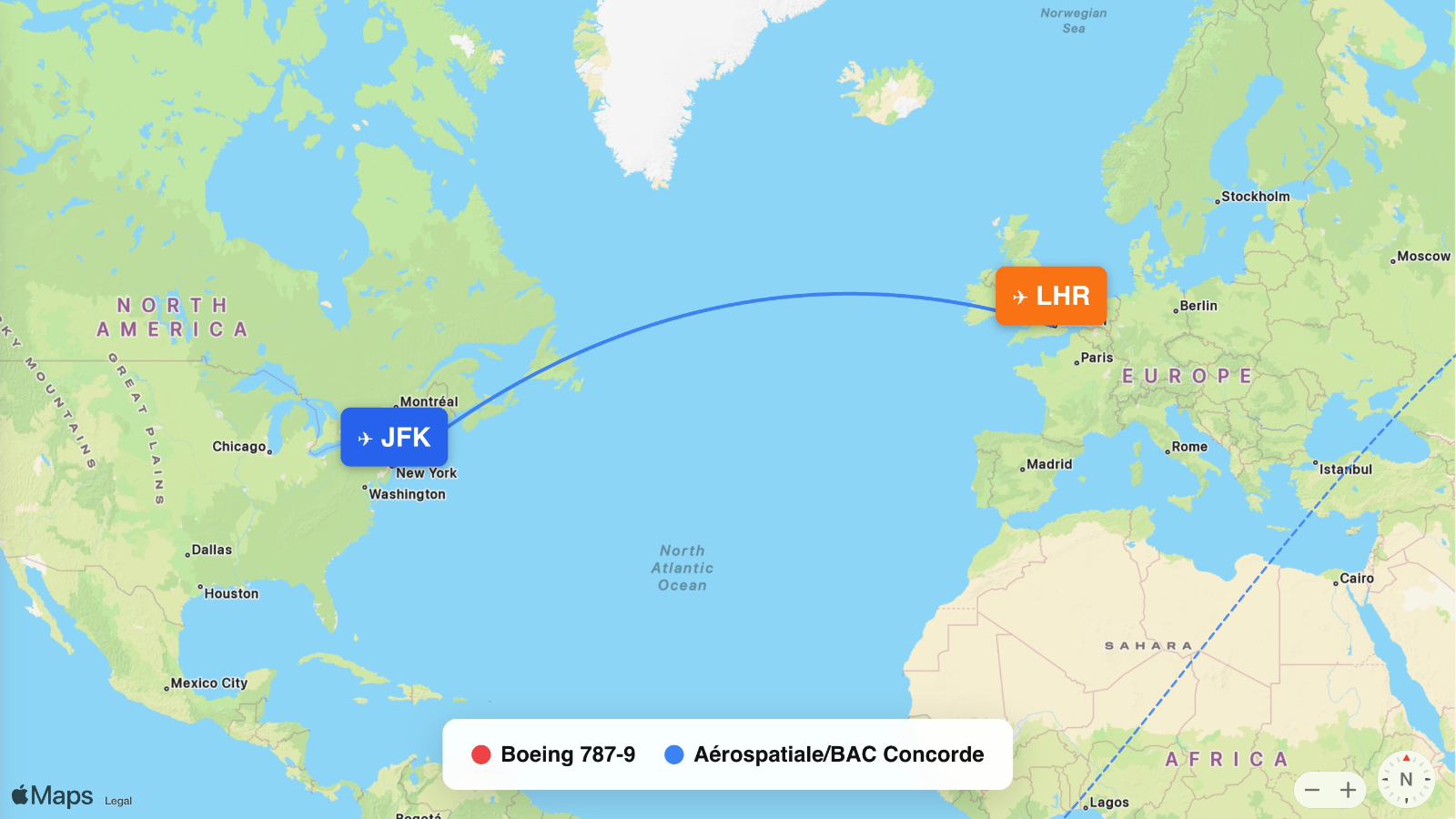
Concorde burned 5,600 gallons of Jet-A per hour. At that rate, Concorde consumed roughly 93 gallons every minute (approximately one full tank of car fuel every ten seconds) just to maintain Mach 2.0 cruise at 55,000 feet. British Airways and Air France flew it for 27 years on the North Atlantic. The economics were never good. The numbers were always extraordinary.
The Boeing 787-9 Dreamliner burns roughly 1,400 gallons per hour at cruise. It carries up to 296 passengers in a typical two-class layout. On New York JFK to London Heathrow, Concorde's defining route at 3,450 nautical miles, the numbers tell a stark story:
| Aircraft | Passengers | Flight time | Total fuel | CO₂ per seat |
|---|---|---|---|---|
| Concorde | 100 | ~3 hrs | ~16,400 gal | ~1,570 kg |
| Boeing 787-9 | 296 | ~7 hrs | ~9,900 gal | ~320 kg |
Concorde burns 65% more total fuel to carry roughly one-third as many passengers. Per seat, it emits nearly five times the CO₂ of the Boeing 787-9 on the same crossing, an aircraft that was not specifically designed to flatter Concorde by comparison. It just does.
Concorde's four Rolls-Royce/Snecma Olympus 593 engines produced 38,050 lbf of thrust each, with afterburner. That afterburner was not optional for the transatlantic mission. Concorde used reheat (the British term for afterburner) to accelerate through the transonic regime and again to sustain Mach 2.0 above the tropopause. At cruise, the engines were operating at the edge of their thermal limits continuously, and the fuel flow reflects every joule of that sustained energy expenditure.
Aerodynamically, wave drag (the resistance caused by shockwaves forming across the airframe at supersonic speeds) increases steeply above Mach 1.0. Concorde's slender ogival delta wing was optimized specifically for supersonic cruise, which made it efficient at Mach 2.0 and mediocre everywhere else. The subsonic segments over populated areas (mandatory for overland legs under international noise regulations) burned substantial fuel at exactly the regime the aircraft was not designed for. The climb to cruise altitude at FL550 cost more fuel per nautical mile than the cruise itself.
There is also an altitude effect: at 55,000 feet, Concorde was above the tropopause and deep inside the stratosphere. Jet-A combustion at that altitude produces contrails and water vapor with a disproportionate atmospheric warming impact relative to subsonic contrails at FL350-FL410. Direct CO₂ emissions are the floor, not the ceiling, of Concorde's climate footprint.
Every aircraft has a max-payload range: the furthest it can fly when loaded to its structural payload limit without trading cabin weight for fuel. For Concorde, that boundary sits at 3,100 nautical miles.
JFK to LHR is 3,450 nautical miles. That means Concorde's most iconic route was 350 nm past its max-payload range, firmly in the payload-trade zone where fuel occupies weight that would otherwise carry revenue passengers. British Airways operated a 100-seat configuration on a 128-seat-capable aircraft; the reduced cabin density was not an act of generosity. It reflected the fuel margin required to complete the North Atlantic crossing at near-maximum load.
The Boeing 787-9's max-payload range is approximately 5,650 nautical miles. On JFK-LHR, the Boeing 787-9 is barely past a third of its efficient range. It operates JFK-LHR the way a car handles a short commute: no strain, no trade-offs, full passengers, full cargo.
British Airways priced Concorde at approximately £2,000–£5,000 one-way on the transatlantic routes in the late 1990s, roughly $8,000–$15,000 in today's money for a single transatlantic crossing. This was not a premium pricing strategy. It was a cost-recovery floor.
The operating cost per block hour on Concorde exceeded virtually every other aircraft in the BA fleet. Spread across 100 seats rather than the 400+ seats on a Boeing 747-400, the per-seat cost structure was structurally unworkable at any ticket price that would generate broad demand. The service survived for 27 years because it was a prestige symbol that both governments had subsidized through development, because a small population of corporate travellers valued the time saving unconditionally, and because both carriers' accounting for the aircraft's true economic costs was creative enough to report it as marginally profitable in some years.
When Concorde retired in 2003 (following the July 2000 Air France crash at Paris CDG, the post-9/11 collapse in premium transatlantic demand, and Airbus's withdrawal of continued airworthiness support), the underlying numbers had not changed. The rationalization for keeping it flying had simply run out.
Load Concorde and a Boeing 787-9 from JFK and set London Heathrow as the destination. The efficiency badges in the stats panel tell the whole story: Concorde reads Stretched: its most famous route sits outside the max-payload range. The Boeing 787-9 reads Efficient. The inner dashed ring on the map marks each aircraft's max-payload boundary: for Concorde it falls visibly inside LHR; for the Boeing 787-9 the boundary is thousands of miles further out.
PlaneRange Pro shows fuel and CO₂ estimates side-by-side. The per-seat numbers for Concorde are not subtle.
See range, specs, and airline configs on PlaneRange:
787-9 Concorde Visualize on the Map →New routes pushed to their limits, new aircraft, and features as they land.