Boeing — Commercial
 Explore the 787-8's range on the map →
The Boeing 787-8 can fly up to 9,890 nautical miles (18,316 km) as a ferry flight with no payload. With a full load of passengers and cargo, the range drops to approximately 5,510 nm (10,205 km). At its cruise speed of 488 kt, that's about 20h 16m of non-stop flying at ferry weight, or 11h 17m fully loaded.
Source: Boeing Orders & Deliveries, as of Aug 2026

Range shown at max payload (full passenger load), with average wind conditions
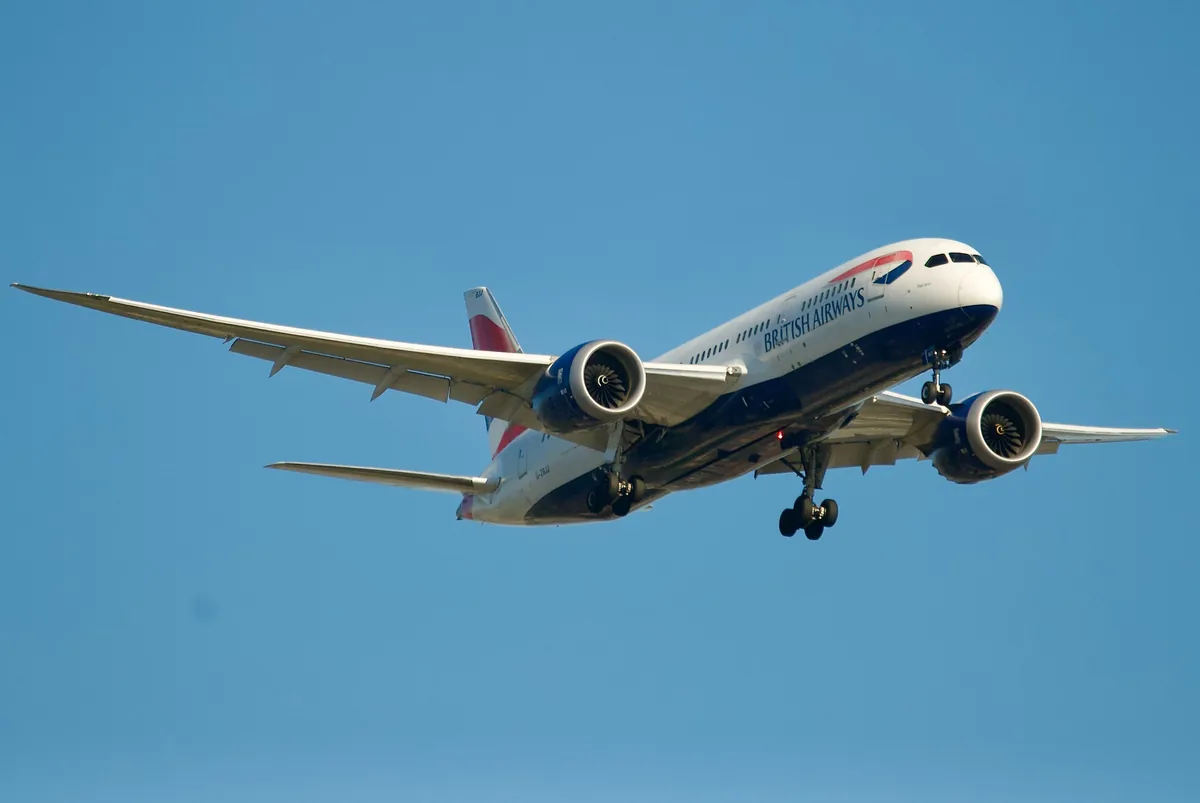
The 787-8 is the aircraft that introduced composite construction to mainstream commercial aviation. More than 50% of the Dreamliner's structure by weight is carbon fiber reinforced polymer - a radical departure from the aluminum that had defined airliner construction since the 1930s. The result is a fuselage that can be pressurized to a higher effective altitude (6,000 feet cabin altitude versus 8,000 feet on aluminum designs) and maintained at higher humidity, producing a measurable difference in how passengers feel after a 12-hour flight. Headaches and jet lag, which are partly a function of low cabin humidity, are measurably less severe.
ANA (All Nippon Airways) was the launch customer and the 787's most loyal early operator, accepting the aircraft despite its infamous 2013 battery crisis: a series of lithium-ion battery fires in the first months of service triggered a worldwide grounding of the entire 787 fleet for three months while Boeing redesigned the battery system. The 787-8 was ANA's gamble on a new technology, and when it paid off, the airline emerged with one of the world's most modern and fuel-efficient long-haul fleets. Ethiopian Airlines and United also operate significant -8 fleets on routes where the smaller capacity (242 seats typical) fits the demand profile better than the 787-9.
The 787-8 is gradually being superseded in new orders by the 787-9, which offers similar fuel burn with significantly more seats. But the -8 retains a niche for routes that generate 200–240 passengers rather than 290+, and its 13,620 km range means there are few long-haul sectors it can't serve. The type has accumulated over a decade of airline service and resolved most of the early production quality issues that gave Boeing's Dreamliner program a turbulent launch.