Flight Analysis & Range Guide
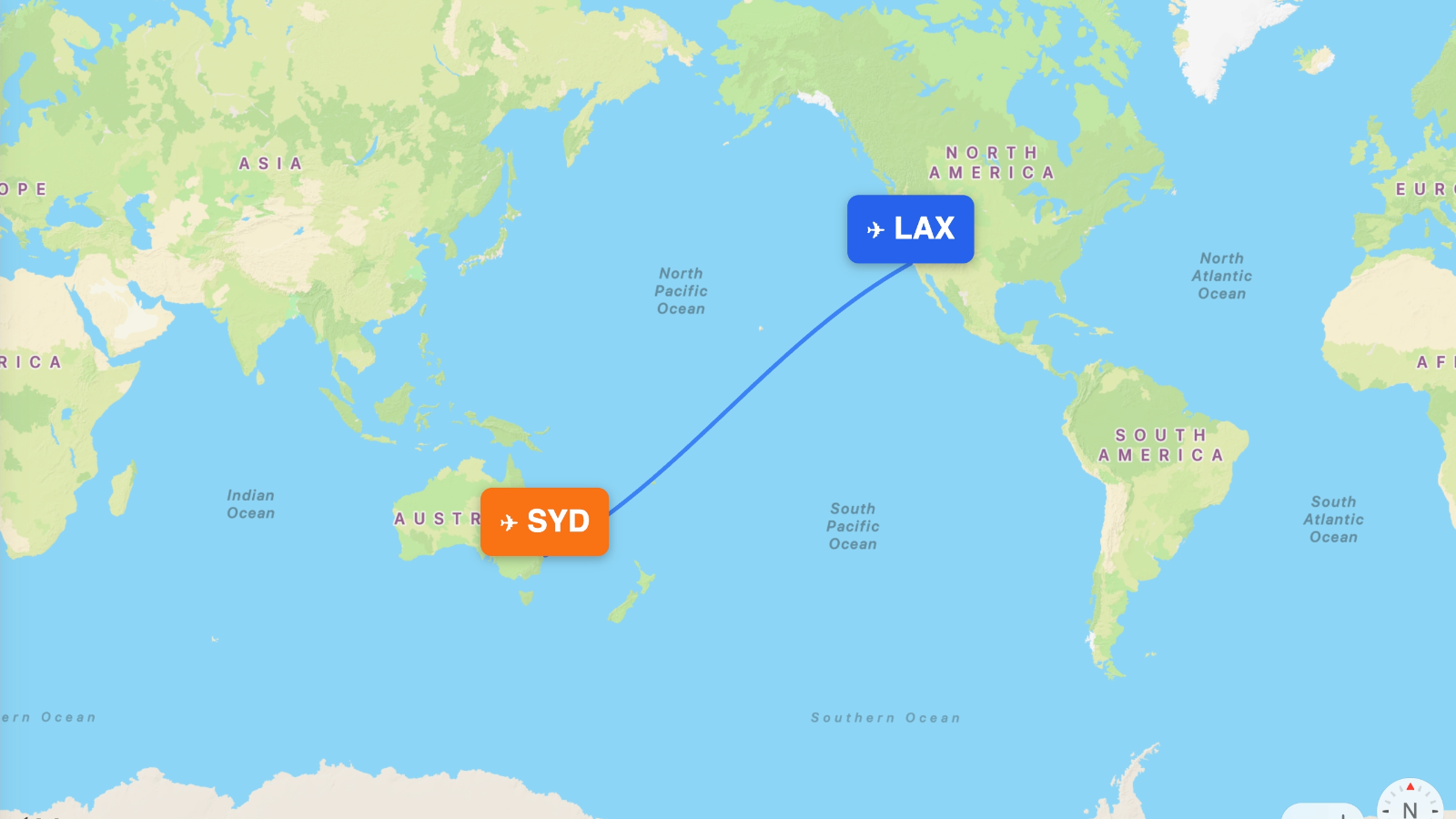
Emirates operates the Boeing 777-200LR between Dubai and Los Angeles — a route covering 8,328 nautical miles. The Boeing 777-200LR's maximum payload range is 7,500 nautical miles. That means the aircraft departs Dubai carrying fuel for a journey that is 828 nm beyond what it can fly at full structural load. To make the numbers work, something has to give: passengers, cargo, or both.
This is what "burning fuel to carry fuel" means in practice. It isn't a metaphor — it's a hard engineering constraint with a direct operational cost that airlines build into their route planning every day.
Every aircraft has a Maximum Takeoff Weight (MTOW) — the structural limit at which the airframe can safely leave the ground. At departure, that weight budget covers everything: the aircraft itself, fuel, passengers, bags, and cargo. When you need more fuel for a longer route, it occupies weight budget that would otherwise carry revenue payload.
On the Dubai–Los Angeles route, Emirates must depart with enough fuel to fly 8,328 nm. That fuel load exceeds what the Boeing 777-200LR can carry at maximum structural payload. The airline's only solution is to reduce payload — capping passenger loads, limiting cargo, or both — to make room within the MTOW ceiling. The 302-seat Emirates Boeing 777-200LR configuration does not operate at full capacity on ultra-long-haul routes for exactly this reason.
The Boeing 777-200LR's ferry range — flying completely empty, every kilogram of payload budget converted to fuel — is 11,500 nautical miles. Its maximum payload range is 7,500 nm. The gap between those two numbers is 4,000 nautical miles: that's the range you sacrifice by filling the cabin.
The relationship isn't linear. Range degrades slowly at light passenger loads and steeply as you approach structural capacity. A Boeing 777-200LR at half-load can still fly well over 9,000 nm. The same aircraft at 90% load may not reach 8,000 nm. The last 10% of passengers cost disproportionately more range than the first 10% — because each additional kilogram of payload requires a disproportionate reduction in fuel to stay within MTOW.
On routes beyond about 9,000 nm, a fuel stop can actually improve the economics. When an aircraft departs with a massive fuel load for a 16-hour nonstop flight, it spends the first several hours of the journey burning fuel solely to lift the fuel it will need for the last several hours. Two shorter legs — say, two 8-hour flights with a quick refueling stop — require dramatically less total fuel, because neither leg carries the weight penalty of the other leg's fuel.
This is why ultra-long-haul nonstops are among the most expensive operations in commercial aviation. The economics only work when the demand for a specific city pair, the premium on nonstop convenience, and the revenue from premium cabin tickets are sufficient to offset the structural payload penalty of carrying an enormous fuel load from departure to destination.
On PlaneRange, load the Boeing 777-200LR from Dubai and watch the range ring at the slider extremes. At zero passengers, the ring extends to 11,500 nm — it reaches virtually anywhere on Earth from Dubai. Drag to full load and the ring contracts to 7,500 nm. That 4,000 nm contraction is the physical cost of filling every seat. Los Angeles, at 8,328 nm, sits beyond the full-load ring — visible proof that Emirates must fly that route below capacity to make it work nonstop.