Flight Analysis & Range Guide
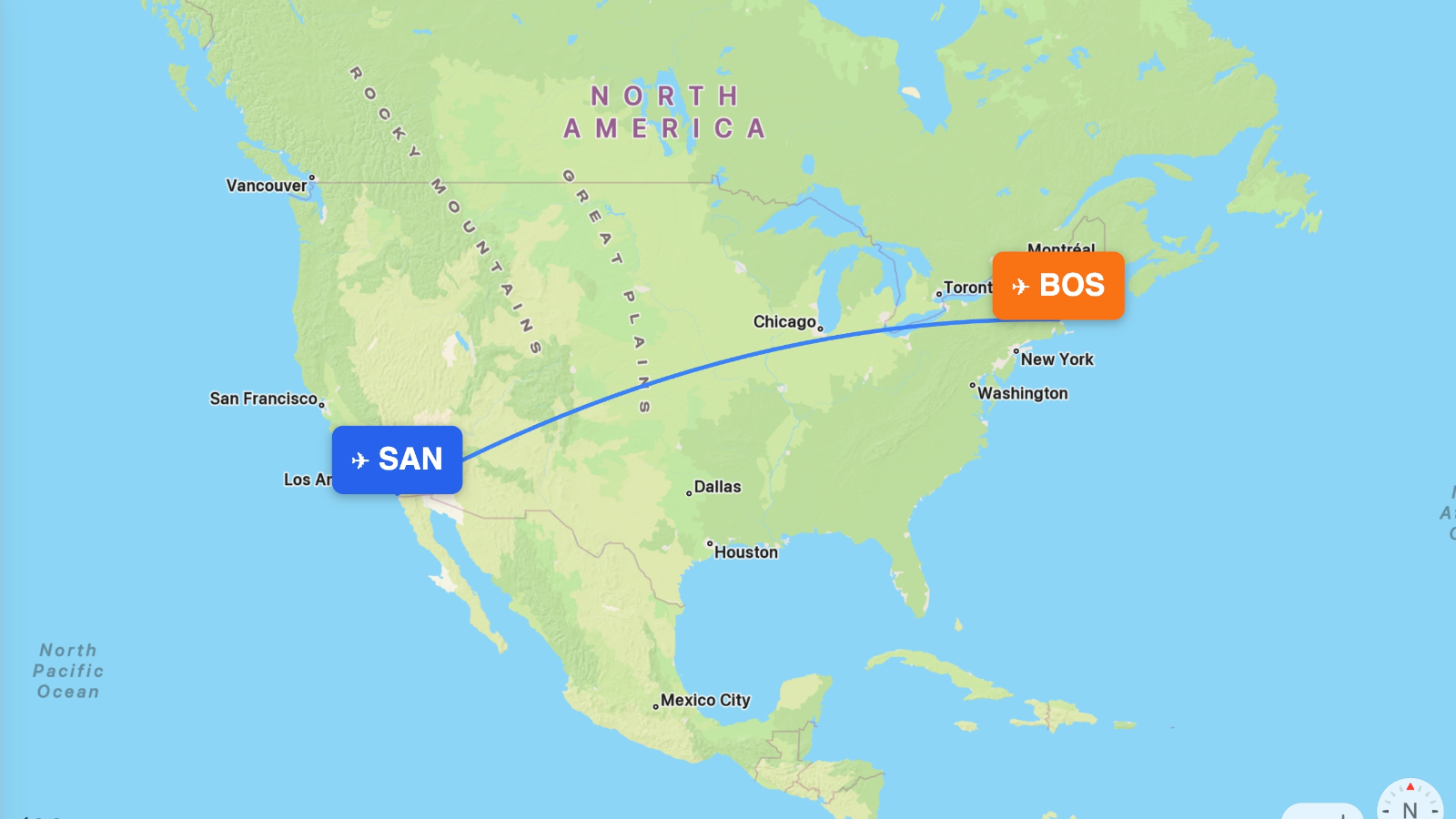
If you've ever looked closely at a transcontinental flight schedule, you'll notice a strange discrepancy: Flying from San Diego (SAN) to Boston (BOS) is often scheduled an hour shorter than the return flight from Boston to San Diego. This isn't an arbitrary airline decision; it's a direct result of the Earth's atmosphere and the powerful Jet Stream.
The Jet Stream is a high-altitude "river" of fast-moving air that flows predominantly from West to East across North America, driven by the planet's rotation and atmospheric heating. When an aircraft flies eastbound (towards Boston), it hitches a ride on this current.
If an airplane has a cruising true airspeed (TAS) of 450 knots and enters a 100-knot Jet Stream tailwind, its ground speed jumps to 550 knots. This significantly reduces flight time and fuel consumption, as the engines are burning fuel for fewer hours to cover the same distance.
On the return leg, that exact same wind becomes a punishing headwind. The 450-knot airplane fighting a 100-knot headwind is now only covering the ground at 350 knots. The aircraft is effectively flying "uphill" through the air, requiring far more fuel to cover the exact same physical distance.
During the winter months, when temperature differentials in the atmosphere are highest, the Jet Stream is at its strongest - regularly exceeding 150 knots in the core. This is why you might see a Boeing 737 MAX or Airbus A321LR reach London easily from New York, but struggle to make it back without a fuel stop in Gander.
Alaska Airlines operates the Boeing 737-800 alongside its newer Boeing 737 MAX fleet. The Boeing 737-800 has a maximum payload range of roughly 2,935 nautical miles - enough to cover the ~2,450 nm from Seattle (SEA) to JFK or BOS on paper. Eastbound, with a tailwind, that's comfortable. Westbound in winter, it's a different story.
Winter headwinds averaging 100 knots inflate the fuel requirement for that leg to the equivalent of flying over 3,200 nm in still air - well past the Boeing 737-800's fuel capacity at full passenger load. Alaska's scheduling team has two levers:
When the plane is full and it's January, airlines get creative. They might swap in a longer-range jet like the Boeing 757-200 or Airbus A321neo, route through a hub like Chicago (ORD), or explicitly weight-restrict the flight to cap passenger loads.
On PlaneRange, you can enable Wind Simulation to see this dynamic visually. The range ring stretches aggressively eastward while compressing sharply to the west - toggle between Winter and Summer to see how much the seasonal difference matters.
See range, specs, and airline configs on PlaneRange:
A320-200 A321-200 A321neo LR 737-800 757-200 Visualize on the Map →