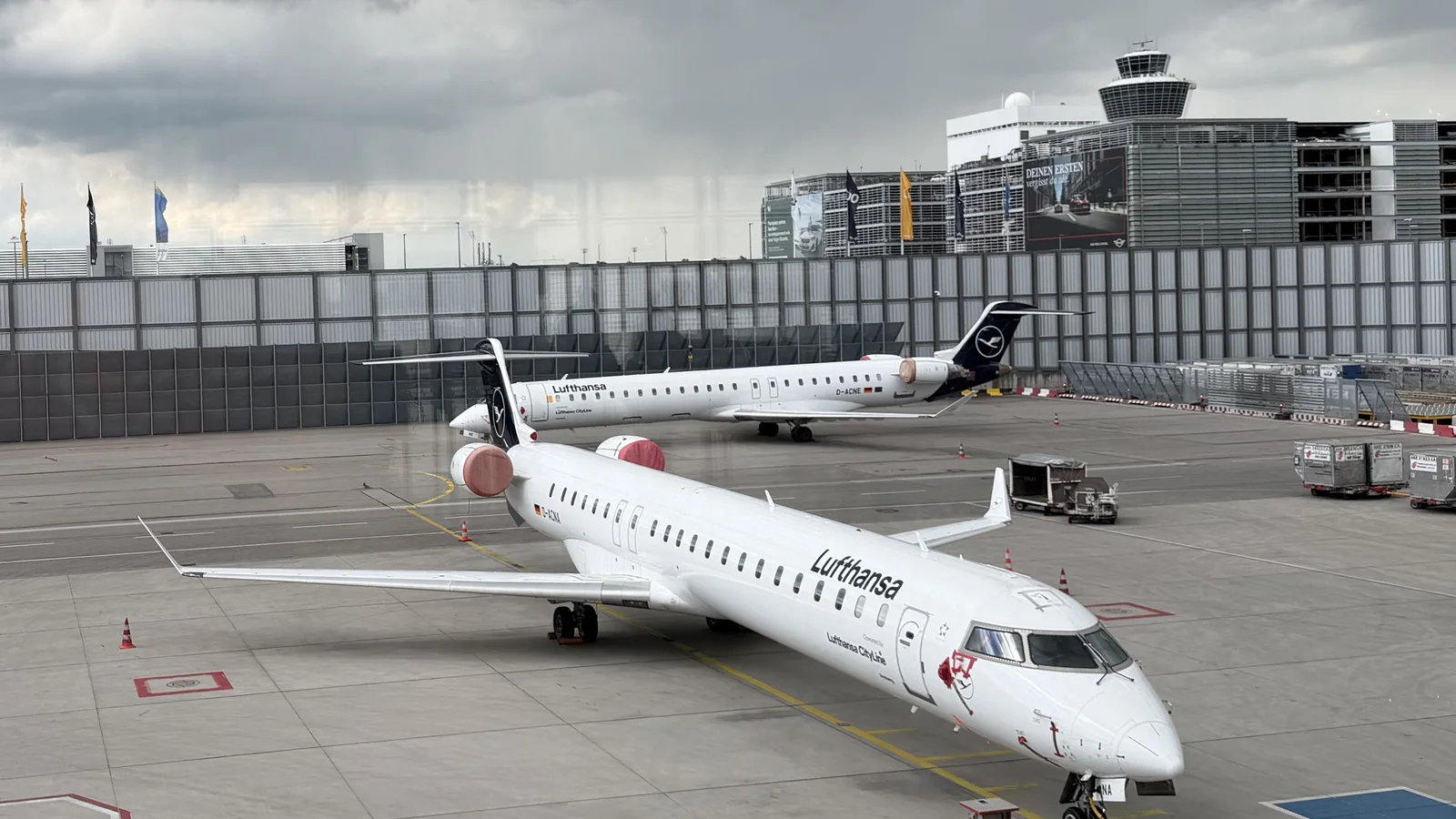
On 18 April 2026, Lufthansa shut down CityLine and grounded all 27 Bombardier CRJ-900s at once. The wind-down had been planned for 2028; a spike in kerosene prices, industrial action, and the maintenance bill on high-cycle airframes pulled it forward by two years.
The coverage settled on "fuel costs killed the regional jet." That's half the story. Fuel prices were the trigger, but they were not what made the CRJ-900 fragile. Put its numbers next to a mainline narrowbody on the same sector and the real problem is obvious - and it isn't the engines.
Take a 350 nm European sector - Frankfurt to London, the kind of leg CityLine flew several times a day - at a realistic 80% load factor. PlaneRange's fuel model gives per-passenger figures:
| Aircraft | Seats | Gal / passenger | kg CO₂ / passenger |
|---|---|---|---|
| Embraer E175 | 76 | 5.18 | 49.6 |
| Bombardier CRJ-900 | 90 | 4.39 | 42.0 |
| Embraer E190 | 108 | 4.13 | 39.6 |
| Airbus A220-100 | 125 | 3.48 | 33.3 |
| Boeing 737-800 | 189 | 3.40 | 32.6 |
| Airbus A320neo | 182 | 2.77 | 26.5 |
Same city pair, same day, same weather. A passenger on the CRJ-900 accounts for 58% more fuel than one on an A320neo. That is not because the CRJ's engines are thirsty; they burn roughly half what the A320neo's do per hour. The problem is that there are only 90 seats to divide that burn between.
Most of what an airliner burns on a short sector is spent getting to altitude and running the airframe through the air - costs that barely change whether the cabin is full of 76 people or 180. Divide a fixed number by a bigger number and the per-seat figure falls. That is the entire economic logic of the mainline narrowbody, and the entire vulnerability of the regional jet.
It shows up inside a single type, too. The CRJ-900 airframe is sold in different densities, and PlaneRange models the real ones:
Same airframe, same engines, same trip. The 76-seat cabin is 18% worse per passenger purely because 14 seats are missing. When fuel is cheap, that gap is a rounding error in the P&L. When kerosene spikes, it is the difference between a route that works and one that doesn't.
Two details made these particular aircraft the first to go. They were flying up to nine legs a day, which piles up cycles - and cycles, not calendar years, are what drive heavy maintenance on a regional jet. Lufthansa's CRJ-900s were only nine to eleven years old but were approaching the end of their economic life on hours and cycles.
Nine short legs a day is also the worst possible duty cycle for per-seat fuel. Every leg pays the climb cost again. A 90-seat jet doing nine hops burns the fixed cost nine times over a small cabin, while an A320neo doing four longer sectors spreads it across 180 seats. The fuel spike simply made an existing gap unaffordable.
One honest caveat about the numbers above: PlaneRange models a flat cruise burn, so it does not charge each leg separately for its climb. The real short-sector penalty on a nine-leg day is therefore larger than the table shows, not smaller. The CO₂ figures are direct combustion only (9.57 kg per gallon of Jet-A) and exclude the roughly 2× radiative forcing multiplier often applied to aviation.
Not another regional jet. Lufthansa is consolidating European feed onto larger narrowbodies - the same trade every legacy carrier in Europe and North America has been making. The regional jet's job was to make thin routes viable at frequencies a 180-seat aircraft couldn't fill. Raise the fuel price and that job narrows to the routes where no larger aircraft fits at all: short runways, small markets, and hub feed that must depart at a specific hour.
The aircraft that survive the squeeze are the ones carrying more people per unit of drag. On the table above, that is the A220 and the E2 family - both around 3.4 gallons per passenger or better, both still in production, both bought specifically to replace 70-90 seat jets with 110-150 seat ones.
Put the CRJ-900 and the A320neo on the map from Munich and drag the passenger slider. The rings barely differ - the CRJ-900 has the legs for any European sector. The difference was never range. It was how many people were on board when the fuel bill arrived.
See range, specs, and airline configs on PlaneRange:
A220-100 A320neo E175 CRJ-900 Visualize on the Map →New routes pushed to their limits, new aircraft, and features as they land.