Flight Analysis & Range Guide
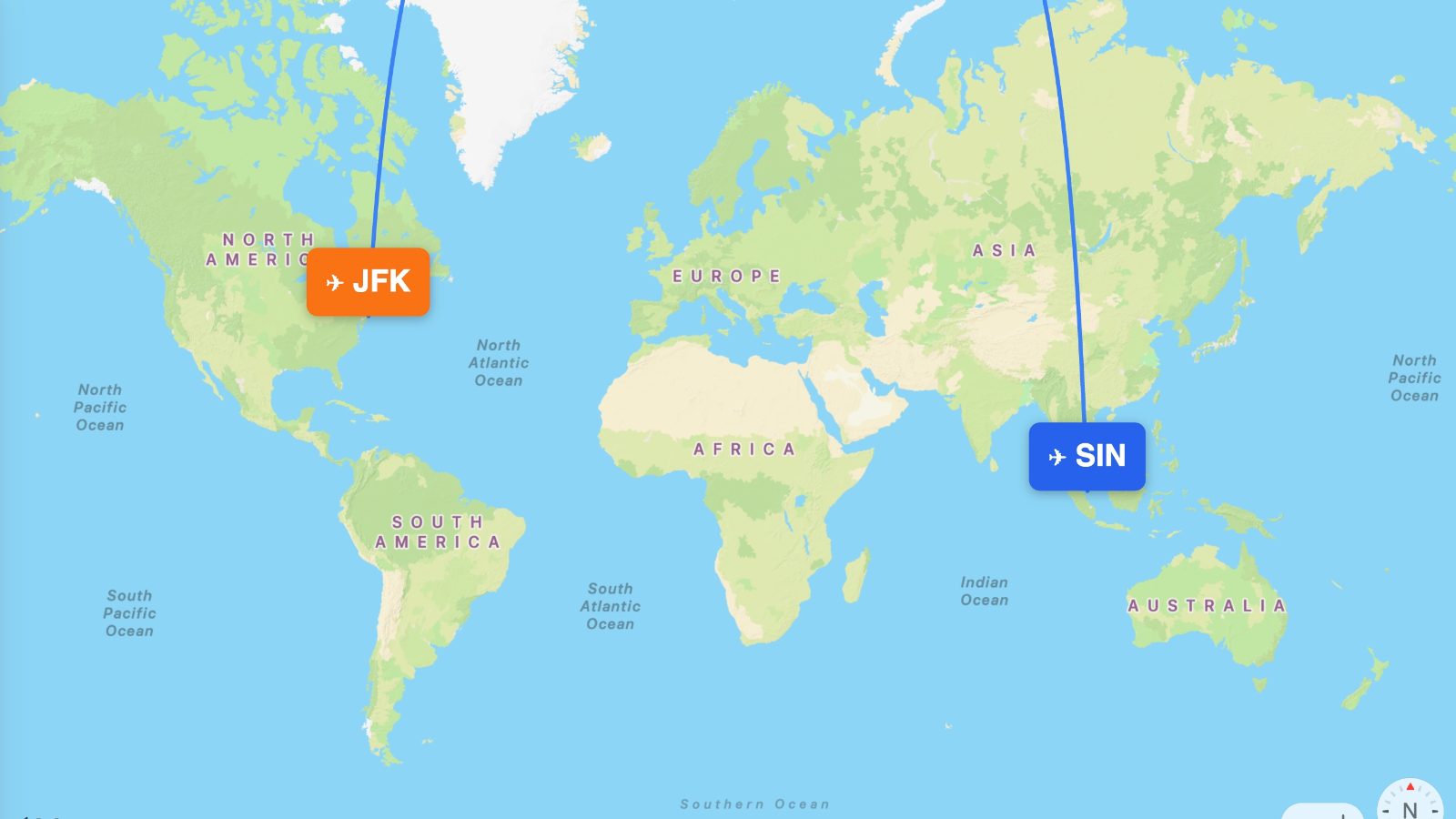
The route from Singapore Changi (SIN) to New York JFK is the longest nonstop commercial flight in the world: 8,288 nautical miles, operated by Singapore Airlines as flights SQ23 (Singapore to New York) and SQ24 (New York to Singapore). The eastbound leg takes roughly 18 hours and 45 minutes. The westbound return, fighting jet stream headwinds across the Pacific, stretches to nearly 19 hours 20 minutes — one of the longest scheduled flight times in aviation history.
To put 8,288 nm in perspective: the standard Airbus A350-900 has a maximum payload range of 8,100 nautical miles. Singapore to JFK is 188 nm beyond that limit. At a conventional seat count, this flight simply cannot happen on a standard aircraft.
Airbus built a specialized variant — the Airbus A350-900ULR (Ultra Long Range) — specifically to make this route work. The solution has two components that work together:
More fuel. The ULR's fuel system was modified to carry 165,000 liters — up from 141,000 liters on the standard Airbus A350-900. That 17% increase in fuel capacity is the physical margin that gets the aircraft across the Pacific and over the American continent.
Fewer, more valuable seats. Singapore Airlines configured the ULR with just 161 seats — Business Class and Premium Economy only, with no economy cabin. Singapore's standard Airbus A350-900 carries 253 passengers. Removing 92 seats reduces structural payload and frees up weight allowance that can instead be used for fuel.
The 161-seat configuration isn't just about weight — it's about revenue. Economy seats on an 18-hour-plus flight are a notoriously poor business: passengers expect a high level of service, cabin crew requirements are intensive, and the per-seat yield is low. Business Class and Premium Economy seats on ultra-long-haul routes command 3–5× the revenue per seat of economy, while taking up 2–3× the floor space.
The economics only work if you accept that this aircraft will never be profitable running a dense, cheap-seat configuration. The 161-seat layout is the price of admission to the world's longest route — and Singapore Airlines has judged that 161 premium seats over 18 hours generates enough margin to justify it.
Load PlaneRange's Airbus A350-900 from Singapore Changi and explore what the standard variant's range ring looks like. Singapore's 253-seat configuration sits well within the aircraft's payload-range envelope — but watch what happens as you drag the slider toward maximum load. The ring contracts toward the aircraft's structural payload limit of 8,100 nm. That limit is what made the ULR variant necessary in the first place.
The gap between the standard A350-900's max payload range and the SIN–JFK distance — just 188 nm — is one of the tightest engineering margins in commercial aviation. It explains why this route, which Singapore Airlines first operated in 2004 (before suspending it in 2013 and relaunching it in 2018 with the ULR), required an entirely new aircraft variant rather than just a schedule adjustment.
SQ24, the westbound return from New York to Singapore, is more demanding than SQ23. The jet stream flows predominantly west to east across the Pacific — meaning SQ24 flies directly against it. The headwind penalty can exceed 600 nm in effective range reduction during winter months. The same aircraft, same fuel load, same passengers — but the ring shrinks dramatically in the westbound direction. It's one of the reasons the SQ24 flight time varies by up to 90 minutes depending on seasonal wind conditions.
See range, specs, and airline configs on PlaneRange:
A350-900 787-9 Visualize on the Map →