Flight Analysis & Range Guide
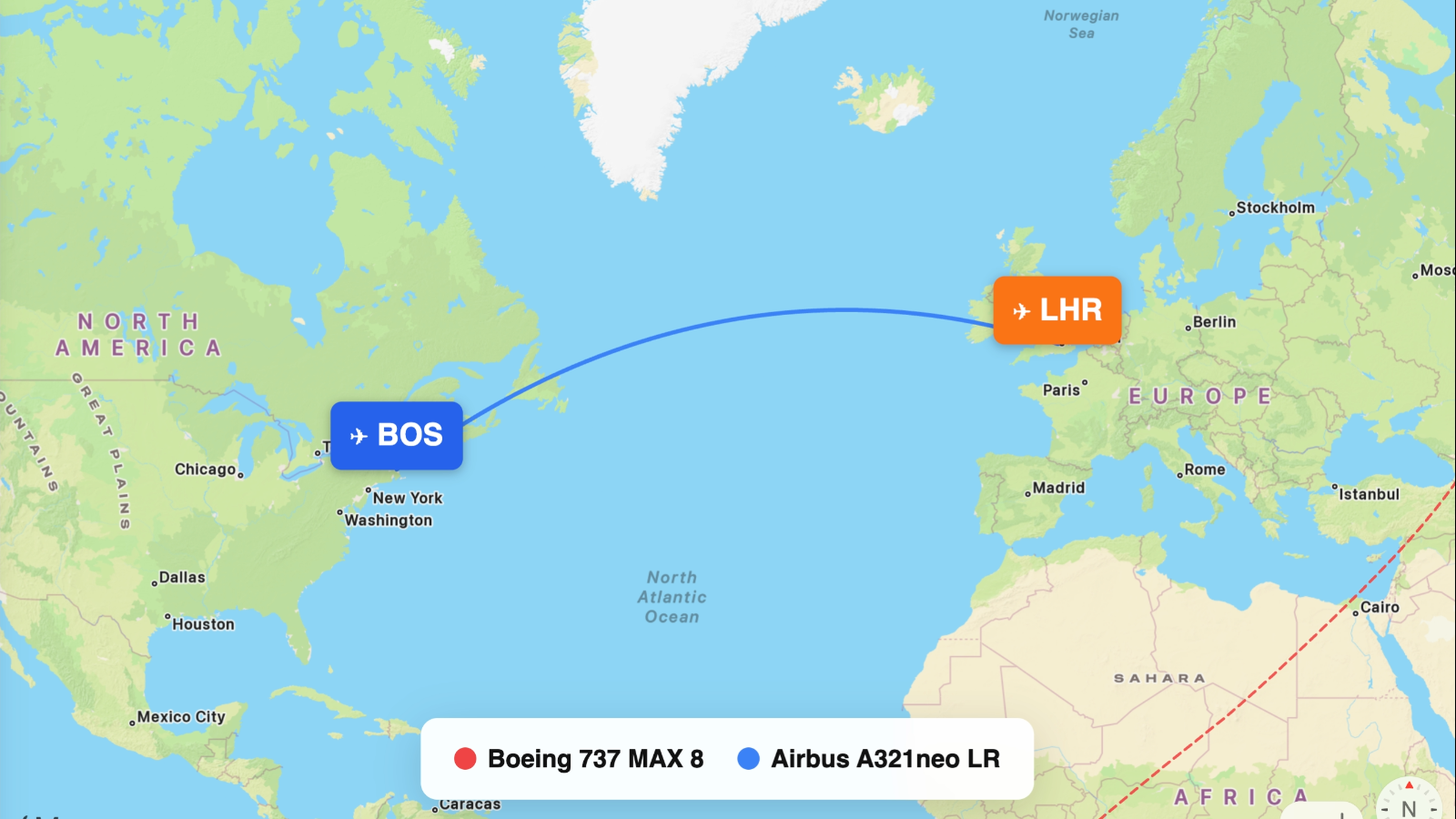
When JetBlue launched its highly anticipated transatlantic service to London, Paris, and Amsterdam, the aviation world praised the carrier for disrupting a market long dominated by legacy widebody operators. But JetBlue's strategy wasn't entirely original. In many ways, they were simply perfecting a playbook written years earlier by an unlikely pioneer: Norwegian Air Shuttle.
Before its financial restructuring, Norwegian Air Shuttle proved something the legacy carriers doubted: that a low-cost carrier could profitably fly narrowbody jets across the Atlantic. Using the Boeing 737 MAX 8, Norwegian launched transatlantic routes from both major hubs like Boston (BOS) and New York (JFK) and secondary U.S. East Coast airports like Providence (PVD) and Newburgh Stewart (SWF), connecting them directly to Ireland, Scotland, and Western Europe.
Norwegian achieved impressive load factors across these routes. They proved that passengers were willing to fly single-aisle aircraft for six or seven hours across the ocean if the price was right and the routing was convenient. The market demand was undeniably there.
JetBlue watched Norwegian's experiment closely. When Norwegian retreated from long-haul flying to survive the pandemic, JetBlue swooped in to capture that proven demand. But instead of flying out of secondary airports like Providence, JetBlue leveraged its massive established hub in Boston (BOS), ensuring a steady stream of connecting traffic to keep those narrowbody jets full year-round.
More importantly, JetBlue chose a more capable aircraft for the mission: the Airbus A321neo-LR (Long Range). While Norwegian pushed the 737 MAX 8 to the absolute limit of its range envelope—often requiring careful fuel planning and facing westbound headwinds—the A321neo-LR gave JetBlue breathing room.
Compare the two aircraft at a full 100% passenger load factor. The Airbus A321neo-LR can comfortably reach deeper into Europe from the U.S. East Coast than the Boeing 737 MAX 8 ever could. Even when facing punishing winter jet streams on the westbound return journey, the A321neo-LR maintains a noticeable range advantage over the MAX 8.
This extra range is crucial. It means JetBlue can confidently schedule flights to deeper European destinations like Amsterdam and Paris without worrying about taking a payload penalty (leaving seats empty or bumping cargo) when the winter headwinds pick up. Norwegian frequently had to grapple with these operational margins; JetBlue’s choice of the A321neo-LR solved the problem.
Norwegian did the hard work of proving the transatlantic narrowbody model could be profitable. JetBlue simply took that validated concept, moved it to a premium hub in Boston, upgraded the aircraft to the A321neo-LR with a lie-flat business class, and captured the market. It’s a textbook example of how being second to market with the right hardware is often more lucrative than being first.
See range, specs, and airline configs on PlaneRange:
A321neo LR 737 MAX 8 Visualize on the Map →