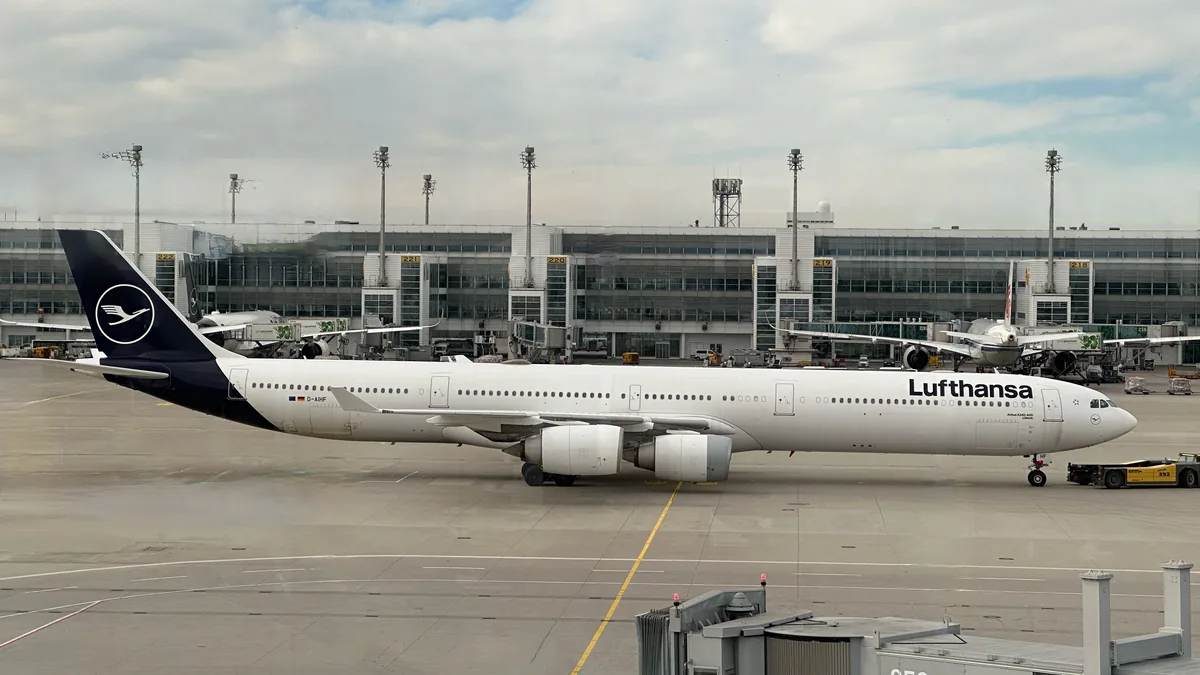
You hand your suitcase to a United agent in Denver. Three hours later, the same bag is being loaded into the cargo hold of a Lufthansa Airbus A350-900 at Newark, headed for Frankfurt. Nobody re-tagged it. Nobody asked you to claim it and re-check it. It just shows up at the carousel in Germany. The system that makes this work is older and more mechanical than it looks, and it is built almost entirely around the barcode printed on your bag tag.
When the agent at the first counter prints your tag, the barcode encodes a 10-digit number known internationally as the License Plate Number, or LPN. This number is unique to your bag for the trip and is linked in a shared database, accessed by every airline that handles the bag, to your full itinerary: every flight, every connection, the final destination, and the passenger record it belongs to. The bag itself does not "know" anything. The number on the tag is a key, and the airline systems hold the lock.
Crucially, the barcode encodes the specific operating flight number for the next leg, not just the destination. A bag headed to Frankfurt via Newark is tagged for LH 400 on the transatlantic segment, not "Frankfurt." That distinction matters when three flights are heading to the same place around the same time, because the system tells handlers which cart the bag belongs on, not just which terminal.
When United and Lufthansa agreed to codeshare, they also agreed to share baggage data through the Star Alliance baggage messaging standard. The moment United generates your tag in Denver, Lufthansa's baggage system at Newark already knows: "A bag tagged 0220-XXXXXX will arrive on UA 1278 and needs to go onto LH 400." When the bag lands at Newark, Lufthansa's transfer team is expecting it. No human at the alliance had to do anything between Denver and Newark. The airlines' systems handled the choreography.
This is why a codeshare ticket can check bags all the way through to the final destination, but a self-connect ticket (where you bought two separate tickets on two separate airlines that do not have an interline agreement) cannot. The data link is what authorizes the bag transfer. Without it, you have to pick up your bag at the connection point and re-check it yourself.
When your inbound aircraft parks at Newark, baggage handlers pull bags from the cargo hold and split them into two streams: terminating bags (passengers ending their trip in Newark, headed for the carousel) and transfer bags (passengers connecting, headed for outbound flights). Each transfer bag is scanned by a handheld reader. The reader returns the next flight: in our case, LH 400. The bag is loaded onto a cart bound for the Lufthansa Airbus A350-900 at its gate.
At the Lufthansa aircraft, every bag is scanned again as it goes into the hold. That scan does two things: it confirms the bag matches a boarded passenger (a security requirement), and it generates a load record the pilots will use for weight and balance. A bag that scans without a matching boarded passenger triggers an investigation before pushback, and is one of the reasons flights get delayed when a passenger checks a bag but does not board.
Airlines publish a Minimum Connection Time for every airport-to-airport pair in their network. At Newark, the international-to-international minimum is around 90 minutes; domestic-to-international is around 60. Most passengers assume that buffer is for them: get to the next gate, find a bathroom. About half of it is for the bag. The bag has to be pulled from a different aircraft, sorted, driven across the apron, loaded into a different aircraft, and recorded in the load plan before pushback. If your connection is 45 minutes and the inbound is 20 minutes late, you will probably make the flight. Your bag probably will not.
This is also why short codeshare connections are riskier than they look on paper. Two airlines means two ground handling teams, two ramp systems, and a handoff between them. A 45-minute connection on a single-airline operation is comfortable. The same 45 minutes between United and Lufthansa at Newark is not.
Newark to Frankfurt has multiple daily departures: Lufthansa's main service, sometimes a second Lufthansa frequency in summer, and historically a United-operated parallel. To a baggage handler running between carts at peak hour, three bags tagged for "Frankfurt" can look identical at a glance. The flight number on the barcode is the only thing that distinguishes them.
Human error is where this system breaks. A bag thrown onto an earlier flight to the same destination becomes an unaccompanied bag: it arrives in Frankfurt before its passenger, gets pulled from the carousel because it does not match an inbound passenger record, and ends up in the airport's mishandled baggage office. When the passenger eventually arrives and files a missing bag report, the system can usually tell them exactly which earlier flight the bag rode on (every scan is logged), but the ironic part is that the bag is sometimes already at the airport, just sitting in a different room than the carousel.
Unaccompanied bags are a security concern, not just a logistics one. Every major aviation regulator requires that, on most international flights, a checked bag must travel on the same aircraft as the passenger who checked it. This is why the gate agent will not let you board your second flight if the airline cannot confirm your bag is on the same plane, and why a passenger no-show triggers a hold while their bag is removed from the hold.
Some narrow exceptions exist (a bag that misses a connection is allowed to follow on the next flight, scanned and matched at the receiving end), but they all involve a documented chain of custody on the bag. The bag tag's barcode is what makes that documentation possible. Strip the tag off, and the bag becomes anonymous, and an anonymous bag in an aircraft hold is a problem nobody wants.
PlaneRange does not model individual bags, but the operational reality of codeshare baggage is part of why route planning is harder than the map suggests. A nonstop Newark to Frankfurt on a Lufthansa Airbus A350-900 has zero bag transfers. A codeshare via Munich adds one. Each handoff has a measurable mis-route rate (around 0.5 to 1% under good conditions, much higher under bad weather). When the map shows that the Boeing 787-9 from a midsize US city can technically reach Lisbon nonstop, the operational reality is that the nonstop is more reliable than a one-stop, partly because the bag never leaves the aircraft.
See range, specs, and airline configs on PlaneRange:
A350-900 787-9 Visualize on the Map →New routes pushed to their limits, new aircraft, and features as they land.