Airbus — Commercial
 Explore the A350-900's range on the map →
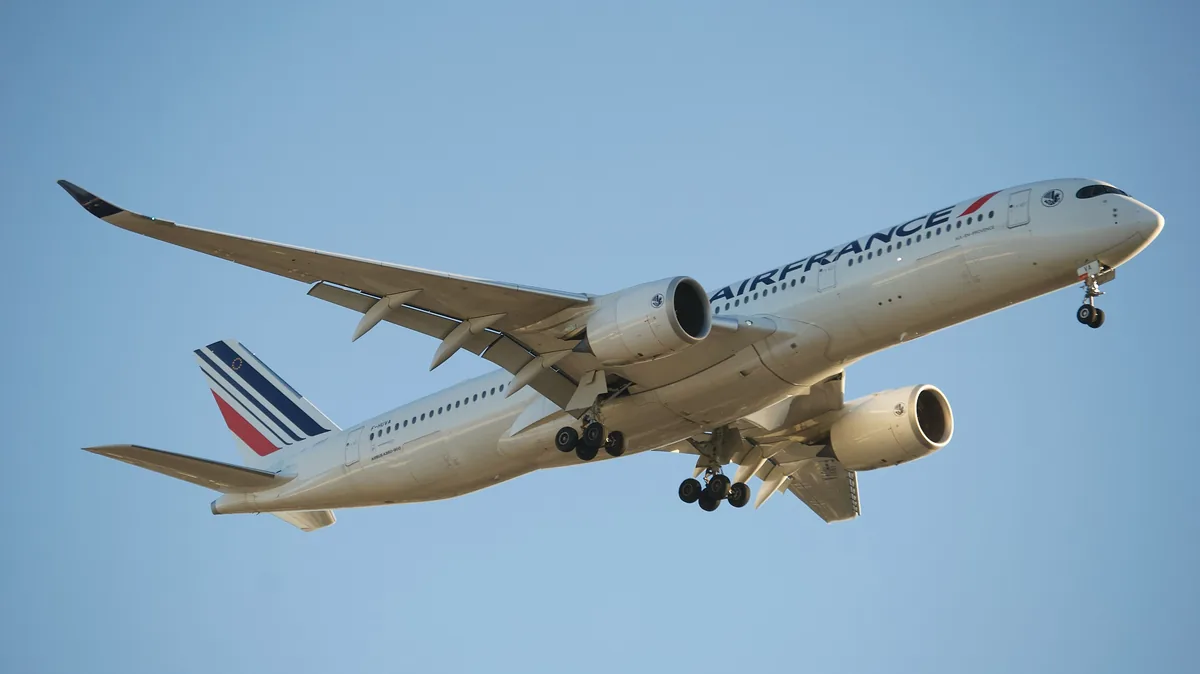
The Airbus A350-900 can fly up to 9,700 nautical miles (17,964 km) as a ferry flight with no payload. With a full load of passengers and cargo, the range drops to approximately 8,100 nm (15,001 km). At its cruise speed of 488 kt, that's about 19h 53m of non-stop flying at ferry weight, or 16h 36m fully loaded.

The A350-900 is Airbus's answer to the 787-9, and depending on who you ask, it either bested Boeing's Dreamliner or lost on price. What's not in dispute: the A350-900's airframe is over 50% composite by weight, its Rolls-Royce Trent XWB engines are among the most efficient high-bypass turbofans ever built, and the result is a widebody capable of missions that no previous twin-engine aircraft could complete.
Singapore Airlines operates the most extreme example: the ULR (Ultra Long Range) variant of the A350-900 flies Singapore–New York JFK nonstop at over 9,500 nautical miles - nearly 19 hours of continuous flight. The ULR achieves this by replacing rear passenger rows with additional fuel tanks, reducing capacity to 161 passengers in a premium-heavy layout, and relying on the Trent XWB's extraordinary efficiency to make the fuel math work. When Singapore launched the route in 2018, it became the world's longest nonstop commercial flight, a record it still holds.
Qatar Airways, Cathay Pacific, and Finnair are among the heaviest -900 operators, typically in more conventional configurations of 300–350 passengers. The aircraft's cabin width - slightly wider than the 787's - and its composite structure (which allows higher cabin humidity and pressure) translate into a measurably better passenger experience on long-haul sectors. The Trent XWB's 97-inch fan diameter is the largest ever fitted to a commercial aircraft engine, and it runs at temperatures that push the limits of nickel superalloy and ceramic thermal barrier coatings.