Airbus — Commercial
 Explore the A220-300's range on the map →
The Airbus A220-300 can fly up to 4,000 nautical miles (7,408 km) as a ferry flight with no payload. With a full load of passengers and cargo, the range drops to approximately 3,100 nm (5,741 km). At its cruise speed of 447 kt, that's about 8h 57m of non-stop flying at ferry weight, or 6h 56m fully loaded.

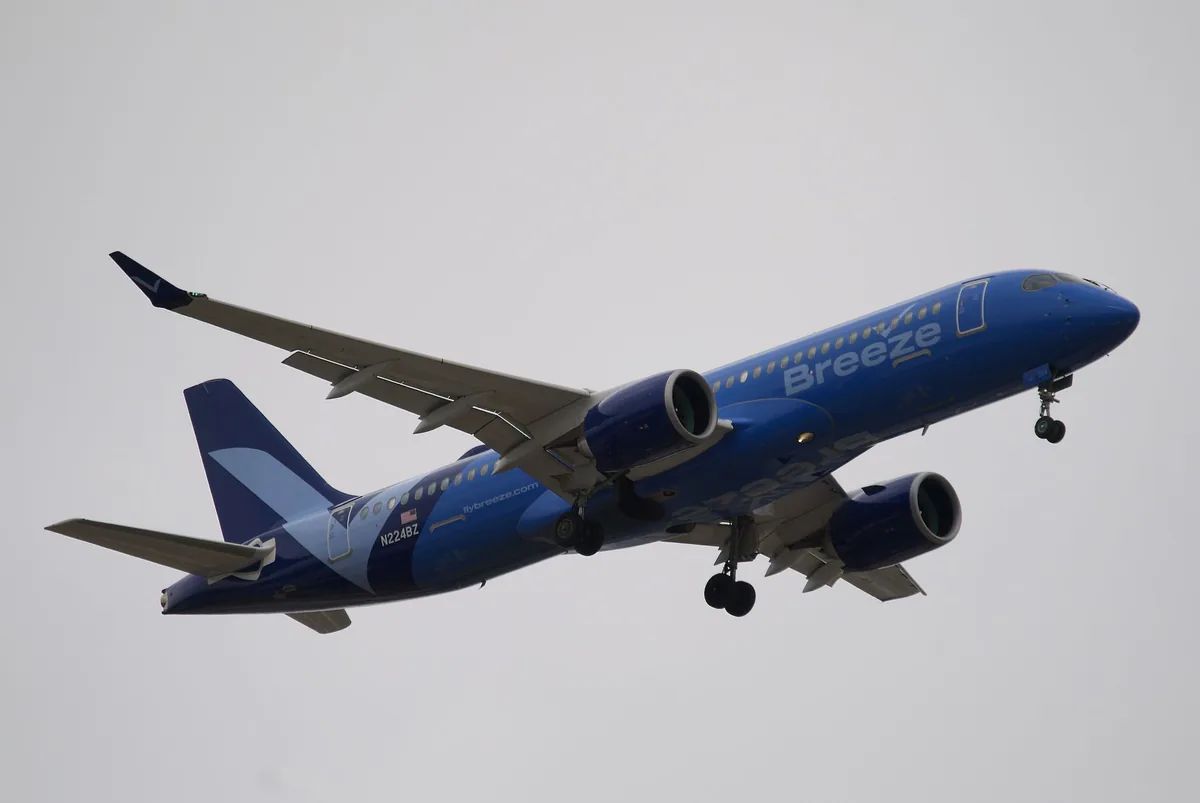
The A220-300 is the stretched sibling of the C Series family, growing the fuselage by 3.3 metres over the -100 to seat up to 150 passengers while keeping the same Pratt & Whitney GTF engines and composite-heavy structure. In practice, most airlines configure it between 125 and 145 seats, giving it a seat count that directly challenges the smaller end of the A320neo family - an awkward internal competition Airbus has so far chosen to manage rather than resolve.
Air France was an early enthusiast, deploying the -300 on dense European routes where its wide, single-aisle comfort is a genuine selling point over older narrowbodies. airBaltic in Latvia built its entire fleet around the type, betting that a single-aircraft strategy reduces maintenance complexity and pilot training costs to a degree that outweighs the range limitations on thinner routes. Korean Air surprised observers by selecting the -300 to replace aging 737-900s, signalling that the type's appeal extends well beyond European regional networks.
For avgeeks, the most interesting aspect of the -300 is how it handles cross-wind landings. The aircraft uses a fly-by-wire system with active side-stick controllers, which means both pilots' inputs are additive - a design choice Airbus uses across its fly-by-wire family. In strong crosswind conditions, the -300's high wing loading (a consequence of carrying a full narrowbody load on a relatively small wing) demands precise technique, and line pilots transitioning from legacy types often note it feels more "honest" than the heavily augmented A320.